
925 Silver Jewelry Production: Polishing and Finishing
Casting gives a silver piece its shape; polishing and finishing give it its price. Three of the eight published factory steps — sprue cutting, high-gloss polishing and brushed or textured surface art — happen before the piece reaches the plating tank, and the MOQ for 925 sterling silver is 50 pcs per design, so finish decisions stay cheap only while they are still on a screen.
Key takeaways
- Three of the eight published steps are finish work: sprue cutting, high-gloss polishing, then brushed or textured surface art.
- Electroplating follows the surface stage — 14K, 18K, 24K gold or rhodium — with an anti-tarnish e-coating added on silver.
- The master sampling window runs 25–30 days, and a second finishing pass costs bench days inside it, not CAD hours.
- MOQ is 50 pcs per design in 925 sterling silver, so a finish change is worth locking in before tooling.
Where finishing sits in the eight-step build
The published shop-floor sequence runs concept design, prototyping, sprue cutting, polishing, surface art, electroplating, final inspection, delivery. Steps three to five are pure finish work, which is unusual for a process list: most factories describe moulding and stop there. The fact that the list names a separate surface stage tells you the bench treats a mirror finish and a brushed finish as two jobs, not one.
Sprue cutting comes first because a cast piece arrives attached to a feed tree. Everything touching that cut edge has to be reworked, and the rework happens before the polishing wheel, otherwise the wheel carries a burr across the whole surface and the mark shows under plating.
Why the surface stage decides how a piece reads online
Buyers judge silver jewellery from images at roughly thumbnail size. At that scale, what survives is not design detail but contrast: a high-gloss face catches light and becomes a bright line, while a brushed or textured area flattens it. A factory that runs both finishes on the same piece can control that contrast, which is why the surface art step exists separately.
Ask for a photograph of the approved sample under the same light as your product page before you sign it off. Plated silver is the one category where a sample can look right on a bench lamp and wrong under a shop light.
What the plating stack does once the surface is ready
Silver goes into a multi-layer precious-metal plating: 14K, 18K, 24K gold or rhodium. Rhodium is the one that keeps the metal looking white and is usually chosen when the piece is meant to read as unplated silver. Gold tones move the piece into a different retail bracket, and multi-layer means the deposit is built up in passes rather than a single dip. No micron figure is published, so treat any number a supplier volunteers as their claim, not the factory's.
On silver and brass the plating is finished with a protective anti-tarnish e-coating. The coating is an oxygen barrier on the metal surface; it slows the reaction that turns silver dark in a drawer, but it does not make the plated layer thicker or the piece scratch-proof.
The silver line publishes four facts that belong on any order sheet: every piece is stamped S925, the kind to sensitive skin, eco-conscious plating chemistry and nickel-free base metal applied on a 925 base, and the same page lists REACH limits on lead, cadmium and nickel, an audited BSCI social-compliance programme and the ISO 9001:2015 standard. Sample testing before production is part of the same offer, so the finish is approved on a physical piece before a batch is scheduled.
Reading the finishing spec before you approve a sample
Four fields belong in that spec: base material, finish family, plating colour and hallmark. Hallmarks are applied by high-precision laser engraving, and the marks published for the workshop are S925, 316L and 18KGP. A hallmark states what the metal is, so it also fixes the rest of the specification — you cannot mark a piece S925 and plate it as brass.
Write the finish in words that survive translation. "High-gloss" and "brushed" are the two the bench already uses; "matte-ish" and "shiny but not too shiny" are sentences that get re-interpreted at every stage after approval.
Anti-tarnish e-coating, and what it is not
The e-coating is applied to silver and brass orders and sits on the plating as a clear barrier. It is not a lacquer over a casting, it is not a warranty against discolouration and it is not applied on stainless steel, which is finished with PVD vacuum plating instead. If your care card says "coated", name the coating.
The practical test is a wear test on the piece you already own: rub a plated silver sample against a cotton cloth for a minute, then look at the cloth. Grey transfer means the top layer is moving. That is the check to run on a 25–30 day sample before releasing the 3–4 week production run behind it.
Comparing finish routes for a first order
| Stage | What is published | What it decides |
|---|---|---|
| Sprue cutting | Step 3 of 8 | Whether edge rework eats bench time |
| Polishing | High-gloss finish, step 4 of 8 | Brightness that survives thumbnail images |
| Surface art | Brushed and textured work, step 5 of 8 | Contrast against the gloss areas |
| Electroplating | 14K / 18K / 24K gold or rhodium, step 6 of 8 | Colour, and whether the piece reads as silver |
| Protective layer | Anti-tarnish e-coating on silver and brass | How long a piece keeps its colour in storage |
Worked example: how much of the build is finish work
Take the eight published steps as the denominator. Finish work — sprue cutting, polishing, surface art — is 3 of 8 steps, or 3 ÷ 8 = 37.5% of the documented process. Add electroplating, the step that only exists because the surface is ready for it, and the count becomes 4 of 8 = 50%.
Now price the same idea in time. The master sampling window of 25–30 days is spread over five bench operations: 3D wax printing, mould casting, stone setting, polishing and electroplating. That is 30 ÷ 5 = 6 days each at the slow end, and 25 ÷ 5 = 5 days at the fast end. Polishing is one of the five, so a change requested after the sample is approved is measured in days, not hours.
The arithmetic is mine; 25–30 days is the published window. A brand that needs a different finish should be raising it while the CAD drawing is still open, in the first 48 hours.
Choosing a custom sterling silver jewelry OEM partner on finish alone
Ask three questions in one message: which finishing operations happen in-house, what the plating schedule is on silver, and what coating the order ships with. A supplier that answers only the first is passing the other two to someone else, and you will find out on the second batch.
Finishing is also the easiest thing to re-specify on a repeat run, because the mould and CAD already exist. Keep the finished sample and the spec sheet together in your own files; the next order starts from those two documents, not from a fresh conversation about "the shiny one".
Frequently asked questions
Does polishing happen before or after plating?
Polishing is step four of eight and comes before the surface art and electroplating stages, so the metal is finished to its final shape and gloss before any plating goes on.
Can I order two different finishes on one silver design?
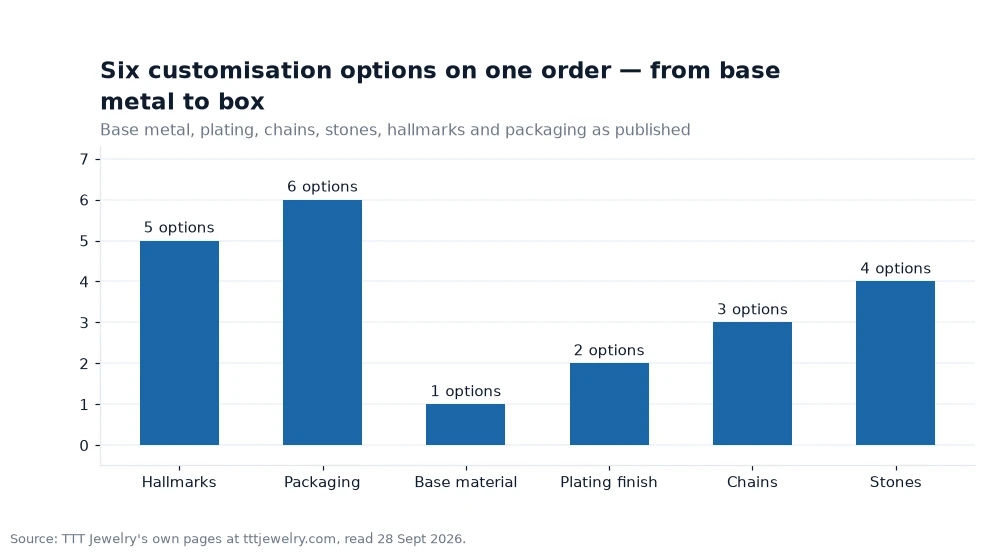
Yes. Brushed or textured surface art and high-gloss polishing are separate published steps, and plating colour is one of the six customisation options, so a single design can carry more than one finish treatment.
What plating colours are available on 925 sterling silver?
Multi-layer precious-metal plating in 14K, 18K or 24K gold, or rhodium; silver and brass orders also receive a protective anti-tarnish e-coating on top of the plated layer.
Planning the finish before the mould
Finish specifications are the last thing brands write and the first thing that goes wrong. Write yours before the CAD file is closed: name the base metal, the surface treatment, the plating colour and the hallmark, then let the workshop price the parts it actually controls. Silver that has to survive a display case before it reaches a customer needs the coating question answered early, and the tooling question answered early too.
Two routes are worth reading side by side before you commit a first order — the factory step list itself, and the plated brass alternative for designs where a gold look matters more than the metal weight.
The source for the claims above — the 100% inspection rule plus the eco-friendly electroplating plus the S925 stamping — is the maker's own pages at tttjewelry.com itself, which I checked on 28 Sept 2026. The tally of steps and days belongs to me rather than the client rather than the manufacturer's[1].