
From Gross to Grid: Putting Power Cost Beside Calculator Output
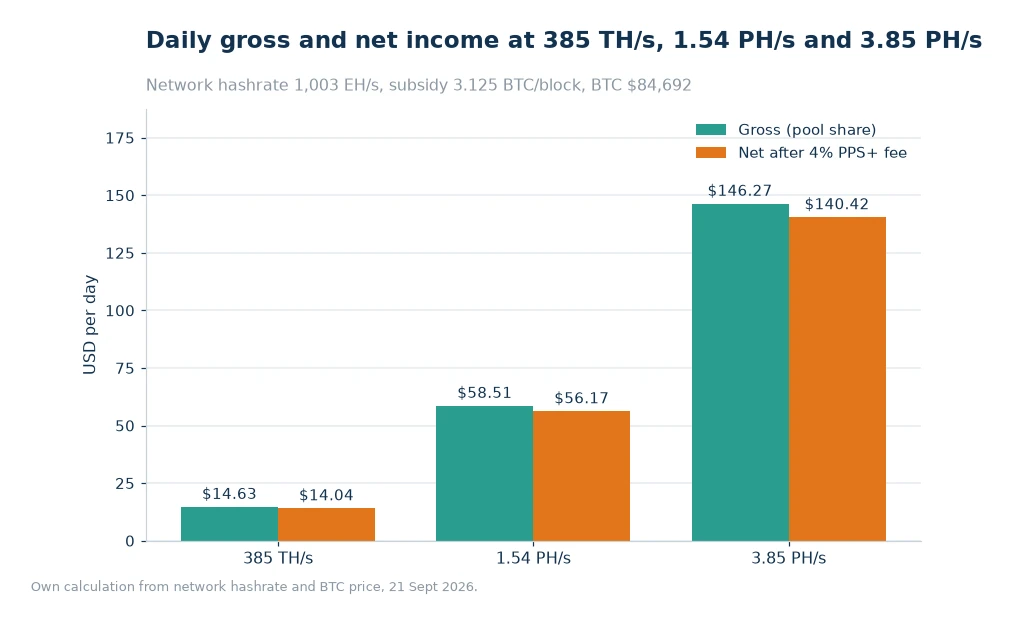
An earnings estimate and an electricity bill are measured in different units, which is why so many miners are surprised by the second one. At 385 TH/s the daily credit is 0.00017271 BTC, or $14.63 at $84,692 per coin, and $14.04 after the listed 4%. At 20 joules per terahash and $0.06 per kilowatt-hour, the same machine burns $11.09 of power to produce it. The gap between those two numbers is the business.

Key takeaways
- At 385 TH/s the credit is 0.00017271 BTC a day, or $14.04 after the listed 4%.
- 20 J/TH at $0.06/kWh costs $11.09 a day, leaving a margin of $2.95 before hosting.
- Moving from 22 to 18 J/TH at the same hashrate saves $2.22 a day in power.
- The break-even power price at this hashrate and efficiency is about $0.076 per kWh.
The number the estimate leaves out
Mining output is a function of hashrate, difficulty, price and fee. Power is a function of watts and tariff. The two are independent, which is good news: you can compute each one separately and subtract. It is also why an estimate that looks healthy can describe an operation that loses money every day, because a machine earning fourteen dollars and costing fifteen is not a small problem, it is the whole problem.
Keep the two ledgers apart in the arithmetic and together in the decision. Output belongs in coins and dollars per day; power belongs in kilowatt-hours and the local tariff. Convert both to dollars per day and the comparison is trivial. Leave one in watts and the other in BTC and the comparison never happens, which is how a spreadsheet ends up with a column nobody reads.
Efficiency is a second hashrate
Joules per terahash is the figure that decides how much of the credit survives. The table holds hashrate at 385 TH/s and changes only the efficiency, at a tariff of $0.06. Nothing about the pool changes across the three rows, which is exactly the point: the machine's design, not the schedule, decides the margin.
| Efficiency | Draw | kWh per day | Power cost | Margin |
|---|---|---|---|---|
| 18 J/TH | 6.93 kW | 166.3 | $9.98 | $4.06 |
| 20 J/TH | 7.70 kW | 184.8 | $11.09 | $2.95 |
| 22 J/TH | 8.47 kW | 203.3 | $12.20 | $1.84 |
Four joules per terahash is worth $2.22 a day here, which is about 15% of the gross credit. That is a larger swing than a change of payout scheme produces at this hashrate, and it is decided at purchase rather than at sign-up. Anyone comparing pools on a tenth of a percent while ignoring a four-joule gap is optimizing the wrong variable.
Get the credit side from the ViaBTC Mining Calculator, then put the meter reading underneath it in a Profit Calculator of your own. Two columns, one for coins and one for kilowatt-hours, and the subtraction happens inside the same sheet. That is a more honest model than any single tool, because the second column depends on a building and a tariff that no pool can see.
What a cent per kilowatt-hour is worth
Tariffs are local and often opaque once demand charges, time-of-use bands and cooling load are included. A rough conversion helps: at 20 J/TH and 385 TH/s, one cent per kilowatt-hour is $1.85 a day, or about $675 a year. Two cents is $1,350. That single line usually explains why identical hardware is profitable in one region and idle in another.
Cooling belongs in the same line. Fans and any active cooling add to the draw, and in a warm climate the difference can be several percent of the total. If the meter reads higher than the nameplate calculation, the gap is usually fans, power-supply losses and the pumps or air handlers that keep the room habitable. Measure it once and use the measured figure thereafter.
Worked example
Take the baseline row and carry it from network to margin.
- Daily network output: 3.125 BTC × 144 blocks = 450 BTC.
- Per TH/s: 450 ÷ 1,003,107,267 = 0.000000448606 BTC.
- At 385 TH/s: 385 × 0.000000448606 = 0.00017271 BTC.
- In dollars: 0.00017271 × 84,692 = $14.63.
- After the listed 4% on the block-reward component: 14.63 × 0.96 = $14.04.
- Power at 20 J/TH: 385 × 20 = 7,700 W, which is 7.7 kW, × 24 = 184.8 kWh.
- At $0.06: 184.8 × 0.06 = $11.09. Margin: 14.04 − 11.09 = $2.95.
- Break-even tariff: 14.04 ÷ 184.8 = $0.076 per kWh.
That last figure is the one worth writing on the machine. Below it the rig pays for itself in operation; above it the rig is converting cheap electricity into expensive electricity with extra steps. Everything else, including the pool fee, is a smaller correction to the same arithmetic.
Read the meter, not the spec sheet
A nameplate figure is measured at the wall under laboratory conditions and a favorable temperature. A working machine in a warm room draws more, and a power supply running near its limit wastes more. Clamp a meter on the feed for a full day, including a hot afternoon, and use that number. The difference is often enough to move a marginal operation from viable to not.
Do the same for the whole room once a month. Aggregating individual machines misses the fans, the network gear, the lights and whatever else shares the circuit. The bill is the ground truth, and a per-machine model that disagrees with the bill by more than a few percent is a model that needs updating before it is used for any decision.
When to stop a machine
The stopping rule is arithmetic, not sentiment. When the daily credit after the listed fee falls below the daily power cost plus any unavoidable hosting charge, the machine costs money to run. That can happen through a price fall, a difficulty rise or a tariff increase, and it can reverse. The decision is whether to wait for a reversal or to stop and preserve the cash.
There is a middle option worth knowing: run the efficient machines and idle the rest. A mixed fleet rarely has a single answer, and treating it as one is how operators end up switching off a profitable unit because the average looked bad. Sort the fleet by margin per kilowatt-hour and the order of switching off becomes obvious.
Keep the accounting current. A multi-currency wallet with Auto Conversion in the same account as the mining dashboard shortens the path from credited coins to the currency that pays the utility, which matters when the margin is a couple of dollars a day rather than a couple of hundred.
Frequently asked questions
How much power does a 385 TH/s machine use?
At 20 J/TH it draws 7.7 kW, or 184.8 kWh a day, which costs $11.09 at $0.06 per kWh against a credit of $14.04 after the listed 4%.
What efficiency should I aim for?
Lower is better, and at 385 TH/s each four joules per terahash is worth about $2.22 a day in power, so compare models on efficiency before comparing them on headline hashrate.
At what power price does mining stop making sense?
For this example the break-even tariff is about $0.076 per kWh, since $14.04 of daily credit divided by 184.8 kWh leaves nothing above that price.
Put the tariff on the same page as the estimate
Two lines, both in dollars per day: what the pool credits after the listed fee, and what the meter costs. If the first is larger, the machine has a reason to run. If it is not, the reason has to come from somewhere other than arithmetic, and that is usually a sign to wait.
The pool state page is a useful check on the other side of the equation, since pool hashrate and luck affect the timing of credits even when the long-run average holds. Neither changes the tariff, and the tariff is what decides whether the machine stays plugged in.
Sources: the ViaBTC calculator, wallet and pool state pages for output estimation and settlement tools[1]. Chain data read 21 Sept 2026: network hashrate 1,003 EH/s, difficulty 132.76 T, 3.125 BTC per block, 144 blocks a day, BTC $84,692. Published 22 Oct 2026; tariffs and efficiency figures are illustrative.